
BMW Cooling System Problems | Rocky Mount, NC
BMW Losing Coolant? 9 Common Causes, Warning Signs & Fixes
A BMW coolant leak can begin as a small amount of fluid escaping from a hose or expansion tank and develop into an overheating problem capable of damaging the engine. Sometimes the coolant level drops repeatedly without leaving a visible puddle.
Are you getting a low-coolant warning in your BMW? Have you topped off the coolant only to see the message return? Perhaps your BMW smells sweet after driving, the temperature warning appears in traffic, or the reservoir looks unusually low when the engine is cold.
These symptoms can indicate an external leak, an internal engine problem, an incorrect coolant level after previous servicing, or a fault involving the cooling-system monitoring equipment. The exact cause depends on your BMW's model, engine, production year and cooling-system design.
The cooling system keeps the engine within an appropriate operating temperature range by circulating coolant through the engine and heat exchangers. When the system loses coolant or cannot circulate it correctly, engine temperature may rise beyond safe limits.
This guide explains nine potential causes of BMW coolant loss, why leaks sometimes remain hidden, the warning signs that matter most, the diagnostic methods technicians use and when driving becomes unsafe.
For BMW owners in Rocky Mount, North Carolina, the goal is simple: understand the problem, protect the engine and seek the correct repair instead of repeatedly adding coolant without identifying why it is disappearing.
Quick Answer: Why Is My BMW Losing Coolant?
A BMW coolant leak occurs when engine coolant escapes from the cooling system. Common potential sources include a cracked expansion tank, deteriorated coolant hose, leaking water pump, thermostat housing, damaged radiator, faulty connector or seal, heater core or an internal engine leak.
A BMW may also display a low-coolant message because of an incorrect fill level or, in some circumstances, a level-sensor or electronic monitoring problem. Such a message does not always prove that coolant is actively leaking.
Important: If your BMW displays an overheating warning, produces steam, rapidly loses coolant or shows signs of severe cooling-system failure, stop in a safe place and shut off the engine. Do not open a hot coolant reservoir. Arrange professional assistance if the vehicle cannot be operated safely.
Is It Normal for a BMW to Lose Coolant?
Recurring coolant loss is not something to dismiss as normal. A properly functioning, sealed cooling system should generally maintain its coolant inventory between services, although apparent levels can change with temperature and after certain service procedures.
Coolant expands as it heats and contracts as it cools. Comparing a warm reservoir reading with a cold reading can create confusion. The correct method depends on the specific BMW model and the instructions in its owner's manual.
After cooling-system work, an improperly completed filling or bleeding procedure can sometimes contribute to subsequent level changes. However, repeatedly needing to add coolant deserves investigation rather than indefinite topping off.
One-Time Low Reading
May require verification of the correct cold level, recent service history and monitoring instructions.
Repeated Coolant Loss
Suggests the need to check for external leakage, internal loss or inaccurate level monitoring.
Overheating or Rapid Loss
Can threaten engine safety and requires immediate precautions rather than continued driving.
Adding coolant may temporarily restore the correct level, but it does not repair a defective component. The underlying cause must be identified.
BMW Coolant Leak Infographic: 9 Possible Causes and Warning Signs
The infographic below summarizes nine potential reasons a BMW may lose coolant, the warning signs drivers might notice and common repair categories.
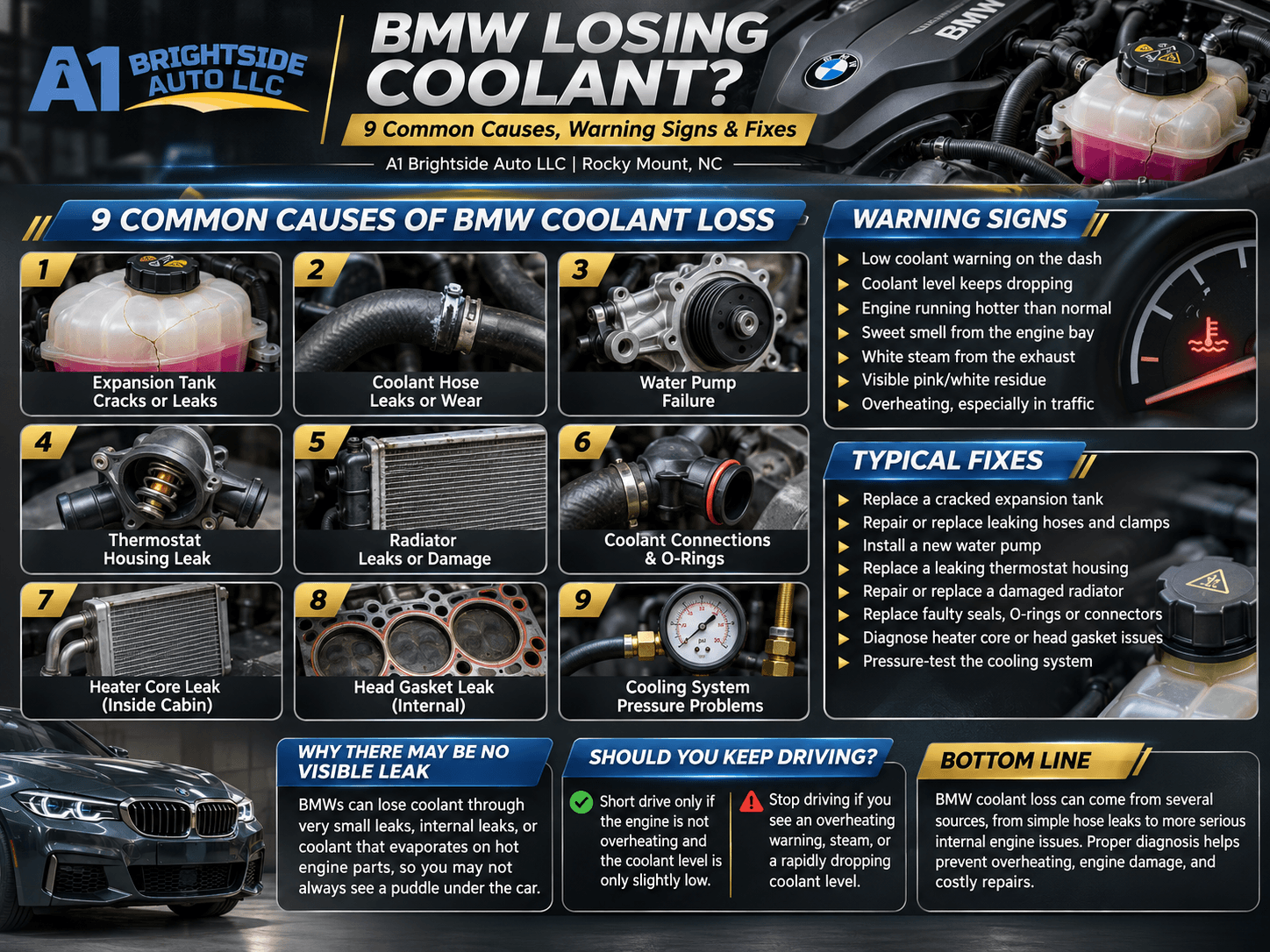
Safety clarification: The infographic's brief driving guidance is not a universal permission to drive a BMW with low coolant. A warning message, suspected leak or uncertain coolant level must be evaluated according to the specific vehicle's instructions. Never continue driving an overheating BMW.
9 Common Causes of BMW Coolant Leaks and Coolant Loss
The following are recognized possible sources of coolant loss or cooling-system concerns. They are not a statistically verified ranking across every BMW vehicle. Some components and failure patterns differ substantially between engine families.
Cracked Coolant Expansion Tank
The coolant expansion tank, sometimes called the coolant reservoir, provides space for coolant expansion and forms part of the pressurized cooling system in many BMW designs.
Plastic expansion tanks experience repeated heating and cooling cycles. Over time, aging or damage can contribute to cracks, seam leakage or problems around connections.
A small crack may leak more noticeably when the cooling system becomes hot and pressurized. Coolant can escape as liquid or leave dried deposits after evaporating.
In some BMW applications, expansion-tank leakage is a manufacturer-documented issue. For example, BMW Service Information Bulletin SI B17 03 24 addresses specified M5 and M8 vehicles and expansion-tank leakage concerns. Its vehicle coverage and repair requirements should not be generalized to every BMW.
Repair approach: Inspect the tank and connections for active leakage. Replace a confirmed damaged component using parts and procedures appropriate for the vehicle.
Leaking or Deteriorated Coolant Hoses
Coolant hoses carry fluid between the engine, radiator and other cooling-system components. Their materials, routing and connections vary among BMW models.
Age, heat, vibration and repeated pressure changes can affect hoses and their sealing interfaces. A hose may develop a crack, become damaged near a connection or leak where it meets another component.
On some BMWs, quick-connect fittings and seals are particularly important to inspect. A leak may appear only when the system is pressurized, making the problem difficult to identify while the vehicle is cold.
Dried coolant residue around a hose junction can provide a clue, but a visible stain does not always prove the connection is currently leaking.
Repair approach: Inspect the affected hose and connections, replace damaged parts and verify the cooling system is properly filled and leak-free.
Water Pump Leakage or Failure
The water pump helps circulate coolant through the engine and associated cooling-system components. BMW uses different pump configurations depending on engine family, including mechanically driven and electrically controlled designs.
A pump can fail mechanically or electrically. Some failures result in external coolant leakage, while others primarily disrupt coolant circulation.
That distinction matters: a water pump can contribute to overheating without producing an obvious puddle, and coolant loss does not automatically prove that the pump is defective.
Depending on the design, leakage may develop near a pump seal, housing or attached coolant connection.
Repair approach: Confirm whether the pump leaks, circulates improperly or has an electrical/control fault before recommending replacement.
Thermostat Housing or Sealing Problems
The thermostat helps regulate coolant flow so the engine reaches and maintains an appropriate operating temperature.
Depending on the engine, the thermostat may be integrated into a housing with sealing surfaces and coolant connections. Leakage can develop around these interfaces if a gasket, seal or housing becomes damaged.
A thermostat that does not function properly may also contribute to overheating or inefficient temperature regulation without necessarily causing external coolant loss.
For that reason, thermostat leakage and thermostat operation are related but distinct diagnostic concerns.
Repair approach: Test the relevant components and replace the failed housing, seal or thermostat assembly only when the diagnosis supports it.
Radiator Leakage or Damage
The radiator transfers heat from engine coolant into the surrounding air. Many radiator designs combine a metal heat-transfer core with additional tanks, connections and mounting components.
Leaks may develop from damage, corrosion, deteriorated seals or aging connections. A radiator can also become damaged by road debris or other external impacts.
Coolant escaping from the front of the vehicle may collect on underbody panels or evaporate when the cooling system is hot.
Not every overheating problem is a radiator leak. Airflow restrictions, cooling-fan faults, circulation problems and other issues can also affect heat rejection.
Repair approach: Confirm the exact source and determine whether an approved repair or radiator replacement is appropriate.
Faulty Coolant Connectors, O-Rings or Seals
BMW cooling systems can contain multiple plastic, metal and rubber components connected by seals, clamps and specialized fittings.
Even when a hose or housing remains intact, an O-ring or sealing interface can become a leak point. Deterioration, physical damage or incorrect installation after servicing can also contribute.
A small connection leak may escape attention because coolant travels down engine surfaces before reaching the ground.
When the engine is hot, coolant can evaporate near the source and leave residue rather than visible drops.
Repair approach: Identify the specific failed interface and replace the required seal, connector or assembly using the correct service procedure.
Heater Core or Heater Circuit Leakage
The heater core uses hot engine coolant to help warm the passenger cabin in many conventional combustion-engine vehicles.
Leaks can develop within the heater core or its related hoses and connections. Depending on the location, escaped coolant may appear inside the cabin, beneath the dashboard or around the vehicle's firewall.
A sweet smell inside the vehicle, persistent windshield fogging or damp carpet may suggest a heater circuit problem. However, these symptoms can also have other explanations.
Low cabin heat does not necessarily mean the heater core itself is leaking; insufficient coolant, circulation problems or climate-control faults can also affect heater performance.
Repair approach: Inspect the heater circuit and related connections to identify whether leakage originates from the heater core or another component.
Internal Coolant Loss or Head Gasket Problems
A head gasket forms a critical seal between the engine block and cylinder head. It helps separate combustion chambers, oil passages and coolant passages.
If this sealing arrangement fails, coolant may escape internally rather than producing a visible external puddle. In some cases, coolant can enter a combustion chamber or another area where it does not belong.
Possible symptoms include persistent unexplained coolant loss, overheating, abnormal exhaust vapor under relevant conditions or other engine performance problems.
White exhaust vapor alone does not prove a head gasket failure. Ordinary condensation can produce visible vapor, especially during cold starts.
Some BMW diesel applications have also had documented coolant-loss concerns involving exhaust-gas recirculation cooling components. These are different from head gasket failures and require engine-specific assessment.
Repair approach: Use appropriate tests to confirm or exclude internal coolant leakage before recommending major engine work.
For broader internal engine concerns, see A1 Brightside Auto's engine repair services.
Cooling-System Pressure, Cap or Level-Monitoring Problems
The cooling system must maintain pressure within its designed operating range. Depending on the BMW, a pressure cap, expansion-tank assembly, seals and related components help manage this process.
A defective pressure-management component can contribute to coolant escaping or boiling under conditions where it should remain contained.
Another possibility is a faulty coolant-level sensor, connection or electronic monitoring system. This can sometimes create a low-coolant warning even when the actual level is correct.
BMW has documented specific false low-coolant message conditions in certain vehicles, including an i8 service bulletin involving software and level-sensor connector concerns. Such examples are not applicable to all models.
Repair approach: Verify actual coolant quantity, inspect system pressure retention and investigate relevant sensors or faults as appropriate.
A pressure cap and a level sensor serve different functions. Neither should be replaced simply because a dashboard warning appears.
BMW Coolant Leak Symptoms: Which Warning Signs Matter?
A BMW can display several symptoms when coolant is escaping or the cooling system is not functioning properly. Their urgency differs.
| Symptom | Possible Explanation | Recommended Response |
|---|---|---|
| Repeated low-coolant warning | Actual coolant loss, incorrect fill level or monitoring fault | Follow vehicle instructions and arrange evaluation |
| Sweet smell near engine | Coolant contacting hot surfaces or escaping from a connection | Prompt inspection |
| Colored or dried residue | Possible external coolant leakage | Trace the actual source; color alone cannot identify the fluid |
| Overheating warning | Potentially unsafe engine temperature | Stop safely and shut off the engine |
| Steam from engine compartment | Possible hot coolant escape or another serious fault | Stop safely and avoid the hot cooling system |
| No cabin heat | Low coolant, circulation fault, heater issue or climate-control problem | Diagnosis based on associated symptoms |
| Persistent unexplained loss | Hidden external leakage or an internal coolant-loss condition | Professional inspection and testing |
| Warning with verified normal level | Possible level-sensor or monitoring issue | Check relevant fault information and sensor operation |
Never Open a Hot Coolant Reservoir
A hot cooling system can contain pressurized coolant capable of causing severe burns. Do not loosen or remove a coolant cap while the system is hot.
Let the vehicle cool completely and follow the instructions for your specific BMW before checking or adding coolant. If steam, heavy leakage or overheating is present, prioritize safety and professional assistance.
Why Is My BMW Losing Coolant With No Visible Leak?
A BMW can lose coolant without leaving a visible puddle because some leaks occur only under specific temperature and pressure conditions.
When an engine is hot, its cooling system becomes pressurized. A small opening in a hose, housing or connector may release coolant while the engine operates but appear dry once the vehicle cools.
Coolant can also collect inside underbody shields, run along hidden engine surfaces or evaporate when it contacts hot components.
In more serious cases, coolant may escape through an internal engine leak. Some applicable engines have additional cooling circuits, so the actual fluid path can be more complex than a conventional radiator-and-reservoir arrangement.
Other possibilities include an incorrectly filled system following service or a sensor that reports a low level when the actual quantity is correct.
How Do Mechanics Find a Hidden Coolant Leak?
Technicians may use a cooling-system pressure test, visual inspection of difficult-to-reach locations, examination for dried coolant deposits and tests appropriate for suspected internal leakage.
A pressure test applies controlled pressure according to the vehicle's specifications and helps identify leaks that may not be visible during a normal cold inspection.
For difficult cases, additional testing may be required after an initial inspection does not identify the problem. A negative first test does not conclusively eliminate every intermittent leak.
Important distinction: A hidden leak is not automatically a head gasket failure. External leaks, internal cooling-system faults, improper filling and level-monitoring issues must be considered based on the evidence.
Can You Drive a BMW With a Low Coolant Warning?
A BMW low-coolant warning should not be treated as automatic permission to keep driving. The correct response depends on the specific warning, coolant level, engine temperature, observed leakage and vehicle instructions.
If the engine is overheating, steam is escaping or coolant is being lost rapidly, stop safely and switch off the engine. Continuing to drive may cause major damage.
| Situation | General Safety Guidance |
|---|---|
| Low-coolant message without overheating | Follow the vehicle-specific warning and owner's manual; check only when safe and cooled |
| Recurring low-coolant warning | Arrange diagnosis rather than repeatedly topping off |
| Visible active coolant leak | Have severity evaluated; avoid driving when safe operation is uncertain |
| Engine overheating | Stop safely, turn off the engine and arrange assistance |
| Steam or rapid coolant loss | Do not continue driving; avoid hot pressurized components |
| Suspected internal leak | Seek professional evaluation; avoid risking engine damage |
Never assume that a warning is harmless because your BMW still seems to drive normally.
What Should You Do When Your BMW Coolant Level Keeps Dropping?
- Read the exact warning. Determine whether your BMW is reporting low coolant, overheating or another cooling-system fault.
- Stop if overheating is indicated. Find a safe location, shut down the engine and avoid continued driving.
- Allow the system to cool. Never open a hot expansion tank or radiator cap.
- Check the level only as instructed. Follow the owner's manual for the engine and coolant circuit involved.
- Use only the specified coolant. BMW coolant requirements vary by model and production details. Do not select coolant based solely on color.
- Document what happens. Record when the warning appears, how quickly the level changes and whether there are odors, stains or steam.
- Arrange diagnosis. If safe operation cannot be established, use appropriate towing or recovery rather than driving to the shop.
Repeated topping off without identifying why coolant is disappearing can mask the severity of a developing problem.
How Is a BMW Coolant Leak Diagnosed?
1. Identify the Vehicle's Cooling-System Design
The diagnostic process begins with the BMW's model, production year, engine and any additional cooling circuits. This determines which components and repair procedures apply.
2. Confirm Actual Coolant Loss
A technician checks the system using the correct fill-level procedure and considers whether recent service could have affected the level.
When a warning is present but the actual coolant level appears normal, sensor and control-system concerns may also be considered.
3. Inspect for External Leakage
Expansion tanks, hoses, radiator connections, water-pump areas, thermostat housings and other components are examined for fresh coolant or dried residue.
4. Test Cooling-System Pressure
An appropriate pressure test can help reveal leaks at connections or components that remain dry under other conditions.
The technician must use the manufacturer's specified pressure and procedure. Excessive test pressure is not an acceptable shortcut.
5. Investigate Suspected Internal Loss
If external leakage is not found, testing may focus on internal coolant-loss paths or other engine-specific concerns.
Depending on the symptoms, relevant tests may include combustion-gas detection, examination of cylinder conditions or other manufacturer-approved procedures.
6. Repair and Verify
After the cause is confirmed, the affected part or connection is repaired. The cooling system is then filled, bled or vacuum-filled as specified, and checked again for leakage and correct operation.
Why proper bleeding matters: Some BMW cooling systems require specific electronic or mechanical filling and bleeding procedures. Incorrectly performed service can leave air in the system or cause inaccurate coolant-level observations.
BMW Coolant Leak Repair Options: What Actually Fixes the Problem?
The correct repair depends on the diagnosed failure. Replacing a water pump simply because coolant is disappearing may not help if the actual fault is an expansion tank connection or radiator leak.
| Confirmed Problem | Possible Repair | Key Consideration |
|---|---|---|
| Cracked expansion tank | Replace affected tank or specified assembly | Use correct part and inspect associated connections |
| Damaged coolant hose | Replace hose or defective fitting | Confirm proper sealing and installation |
| Water pump leakage or failure | Repair or replace affected pump assembly | Differentiate leakage from circulation or electrical failure |
| Thermostat housing leak | Replace failed seal, housing or assembly | Verify the actual leak source |
| Radiator leak | Repair or replace as appropriate | Inspect adjacent components |
| Connector or O-ring leak | Replace failed seal or connection | Use the correct design and installation method |
| Heater circuit leak | Repair affected heater core or lines | Confirm location before dashboard disassembly |
| Internal engine leak | Engine-specific repair after testing | Avoid major repairs without diagnosis |
| Pressure or sensor fault | Repair confirmed cap, pressure-management or monitoring component | Distinguish false warnings from real coolant loss |
Once the repair is complete, the cooling system must be filled with the appropriate coolant and checked for correct pressure retention, circulation and operating temperature.
How Much Does BMW Coolant Leak Repair Cost?
BMW coolant leak repair costs vary according to the failed component, engine layout, labor accessibility, parts requirements and any damage caused by overheating.
Replacing an accessible hose or seal may be relatively straightforward. A water pump, heater core or internal engine repair can be substantially more labor-intensive.
No single price accurately describes every BMW coolant leak. Costs also depend on whether the cooling system has multiple circuits or special bleeding requirements.
| Repair Category | General Labor Complexity | Important Variables |
|---|---|---|
| Hose or connector repair | Lower to moderate | Part access and connection design |
| Expansion tank replacement | Lower to moderate | Model-specific location and associated components |
| Thermostat housing repair | Moderate to higher | Engine arrangement and required disassembly |
| Water pump repair | Moderate to higher | Pump design, electrical controls and access |
| Radiator replacement | Moderate to higher | Cooling-system layout and surrounding components |
| Heater core repair | Potentially substantial | Interior access requirements |
| Head gasket or internal repair | Potentially substantial | Diagnostic findings and engine condition |
These categories describe relative repair complexity, not verified local prices or estimates for your specific vehicle.
Before approving expensive repair work, ask which component was confirmed to be leaking, what diagnostic evidence supports the recommendation and how the repair will be verified.
Can a BMW Coolant Leak Cause Engine Damage?
Yes. Severe coolant loss can reduce the cooling system's ability to control engine temperature. If overheating continues, critical engine components may be damaged.
Possible consequences include cylinder-head distortion, gasket damage and other mechanical problems. The severity depends on the temperature reached, duration of overheating and engine design.
Coolant escaping near electrical or fuel-system components can create additional concerns on certain vehicles.
BMW's 2024 expansion-tank service campaign for specified M5 and M8 applications documents a situation where leaking coolant may contaminate nearby fuel injectors. This is a particular engineering issue, not a universal characteristic of all BMW engines.
The most effective way to reduce the risk of secondary damage is to respond to significant coolant loss and overheating warnings before continuing normal vehicle operation.
Are Some BMW Models More Prone to Coolant Leaks?
There is no reliable single ranking of BMW models most likely to lose coolant without accounting for model year, engine, mileage, service history and the underlying data.
Some BMW engines have documented cooling-system faults addressed in manufacturer service bulletins or campaigns.
For example, BMW's SI B17 03 24 concerns certain M5 and M8 production applications and expansion-tank leakage. Different service information documents coolant-circuit concerns affecting other BMW engine configurations.
Such documentation establishes that particular issues have been identified in specified applications. It does not establish that every vehicle with the same model badge has the problem.
When researching your BMW, verify its production details, engine and applicable campaigns or service information using the vehicle identification number.
For official recall status, use NHTSA's recall lookup and BMW's authorized vehicle-specific resources.
Can You Prevent BMW Cooling-System Problems?
Maintenance cannot eliminate every unexpected failure, but several practices can help owners identify problems before they escalate.
- Follow BMW's maintenance guidance. Use inspection and coolant service procedures appropriate for the vehicle.
- Use the specified coolant. Coolant chemistry and compatibility matter more than appearance or color.
- Investigate repeat warnings. A coolant message returning after repeated top-offs is a reason to seek diagnosis.
- Pay attention to odors and residue. A sweet smell or dried deposits may indicate leakage that is not immediately visible.
- Check after repairs. If cooling-system work was recently completed, follow up when the level changes unexpectedly.
- Do not ignore overheating. Continuing to operate an overheated engine can cause serious damage.
- Maintain service records. Previous thermostat, pump, hose or reservoir work can be relevant when diagnosing a recurring problem.
A cooling-system inspection is particularly worthwhile if you are experiencing unexplained fluid loss before a long trip or extended highway journey.
BMW Coolant Leak Repair in Rocky Mount, NC
A1 Brightside Auto LLC offers BMW repair and automotive maintenance services in Rocky Mount, North Carolina.
If your BMW keeps losing coolant, the first priority is determining whether the problem is active external leakage, a circulation issue, incorrect fill level or a more serious internal concern.
Before contacting the shop, gather your vehicle's model, year, approximate mileage and any dashboard warning messages. Describe whether you see stains, smell coolant, experience low cabin heat or have noticed overheating.
If the engine is overheating or rapidly losing coolant, arrange safe assistance rather than attempting to drive it to an appointment.
Business: A1 Brightside Auto LLC
Address: 1826 Sunset Ave, Rocky Mount, NC 27804
Phone: (252) 231-3301
Business hours: Monday–Friday, 8:00 AM–6:00 PM
BMW Coolant Keeps Disappearing?
Discuss your BMW's coolant-loss symptoms with A1 Brightside Auto and ask about available diagnosis and repair services. Knowing the actual source is the first step toward the right solution.
Explore BMW Repair Services Call (252) 231-3301For more serious overheating-related engine concerns, review A1 Brightside Auto's engine repair services.
Frequently Asked Questions About BMW Coolant Leaks
1. Why does my BMW keep losing coolant?
A BMW may repeatedly lose coolant because of an expansion-tank leak, damaged hose, leaking water pump, thermostat housing, radiator connection or another cooling-system problem. Internal coolant loss and improper filling after service are additional possibilities. A low-coolant warning can sometimes occur without an active leak. The correct diagnosis requires confirming the fluid level and investigating the system.
2. Why is my BMW losing coolant but there is no visible leak?
Coolant may escape only when the cooling system is hot and pressurized, collect on hidden engine or underbody surfaces, or evaporate before forming a puddle. Internal coolant loss is another possibility. A level-monitoring problem may also create an incorrect warning. Appropriate pressure testing, inspection and additional diagnostics can help distinguish these conditions.
3. Is it safe to drive my BMW with a low-coolant warning?
It depends on the exact warning, coolant level, engine temperature and vehicle-specific instructions. A low-coolant notification is not automatically permission to continue driving. If the engine overheats, steam appears or coolant is being lost rapidly, stop safely and shut down the engine. When uncertain whether driving is safe, arrange professional assistance rather than taking the risk.
4. Can a BMW water pump fail without leaking coolant?
Yes. A water pump may fail electrically or mechanically and disrupt coolant circulation without producing an obvious external leak. Some pump failures involve leakage, while others primarily affect cooling performance. Overheating or fault codes do not automatically prove that the water pump is responsible, so the pump and related controls should be evaluated before replacement.
5. How do I know if my BMW expansion tank is leaking?
Possible clues include wetness near the tank, dried coolant deposits around seams or fittings, repeated low-coolant messages and a sweet odor after driving. Some leaks appear only when the system is hot and pressurized. A professional inspection can establish whether the tank itself is damaged or coolant is escaping from an adjacent hose or connection.
6. Why does my BMW smell sweet after driving?
A sweet smell may indicate coolant escaping from the cooling system and reaching warm engine components. Possible sources include hoses, the expansion tank, radiator connections or other cooling-system parts. The odor alone cannot identify the failed component. If the smell accompanies steam, overheating or rapid coolant loss, stop safely and seek assistance rather than continuing to drive.
7. Does a BMW coolant leak always cause overheating?
No. A small coolant leak may exist before the vehicle displays an overheating warning. However, continued coolant loss can eventually compromise cooling-system performance. Conversely, overheating can result from circulation, fan, thermostat or other problems without an external leak. Both coolant loss and abnormal engine temperature should be evaluated according to their severity.
8. Can I use water instead of BMW coolant?
BMW cooling systems require the correct coolant specification and mixture for the vehicle. Plain water is not an appropriate routine substitute because the specified coolant provides corrosion protection, freeze protection and other necessary properties. Emergency instructions may vary by model and situation. Follow your BMW owner's manual and do not add any fluid to a hot pressurized system.
9. How much does it cost to repair a BMW coolant leak?
The cost depends on the diagnosed cause, engine design, parts and labor access. A hose or connection repair may be relatively straightforward, while a heater core, water pump or internal engine repair can involve greater labor. A trustworthy estimate requires inspecting the specific vehicle and identifying the actual failed component before recommending replacement.
10. Can a BMW head gasket cause coolant loss without a puddle?
Yes. Some head gasket failures allow coolant to escape internally rather than through an external opening. However, unexplained coolant loss does not automatically mean the head gasket has failed. Small external leaks, cooling-system connections and other internal coolant paths can create similar symptoms. A technician should use appropriate testing before recommending major engine repairs.
11. Why does my BMW show low coolant after I already topped it off?
The coolant level may still be incorrect, the system may have an active leak or air may remain after servicing. In some applications, a coolant-level sensor or monitoring fault can also cause an inaccurate message. The next step is to verify the correct level using the vehicle's instructions and inspect the system rather than repeatedly adding fluid without diagnosing the issue.
12. Where can I get a BMW coolant leak inspected in Rocky Mount, NC?
A1 Brightside Auto LLC offers BMW repair and maintenance services at 1826 Sunset Ave, Rocky Mount, NC 27804. Call (252) 231-3301 to describe your vehicle's year, model, mileage and cooling-system symptoms and confirm available service. If the BMW is overheating, producing steam or rapidly losing coolant, arrange safe transportation rather than driving it to the shop.
Final Takeaway: Find the Cause Before Replacing Cooling-System Parts
BMW coolant loss can originate from a damaged expansion tank, leaking hose, radiator connection, water pump, thermostat housing or another cooling-system component. Some problems are intermittent or hidden, while others involve internal coolant loss or inaccurate monitoring.
The key is to confirm whether coolant is actually disappearing, locate the source and determine whether the vehicle remains safe to operate.
Repeatedly topping off coolant without diagnosis may delay the correct repair. Likewise, replacing multiple cooling-system parts without testing can create unnecessary expenses.
If your BMW is displaying a low-coolant warning or experiencing recurring fluid loss, contact A1 Brightside Auto LLC for BMW service information in Rocky Mount, NC.
Sources and Technical References
1. BMW of North America — SI B17 03 24, Replace the Coolant Expansion Tank (May 15, 2024).
Manufacturer guidance covering a specific expansion-tank concern in certain BMW M5 and M8 applications.
View BMW technical bulletin
2. BMW of North America — SI B17 06 17, Coolant Leak from Low-Temperature Cooling Circuit (December 8, 2022).
A manufacturer example of an engine-specific cooling-circuit problem involving selected BMW engine applications.
View BMW cooling-system bulletin
3. BMW of North America — SI B17 03 18, Check Control Message Top Up Coolant (March 20, 2019).
Documents specified coolant-level messaging problems involving certain BMW i8 applications. Not general evidence for all BMW models.
View service information
4. National Highway Traffic Safety Administration — Vehicle Safety Recalls.
Official vehicle-specific recall lookup using the VIN.
Check vehicle recall information
5. A1 Brightside Auto LLC — BMW Repair Services.
Local BMW repair and maintenance information for Rocky Mount, North Carolina.
Visit BMW repair page
Evidence status: Technical sources reviewed November 10, 2026. Manufacturer bulletins apply only to their stated model and production coverage. The nine causes described in this article are potential failure sources rather than a verified ranking of BMW failure frequency. Diagnosis, repair decisions and coolant specifications depend on the exact vehicle.