
European Vehicle Reliability | 2026 US Comparison
What Is the Most Reliable European Car Brand in the US? 2026 Rankings
BMW, Porsche, Mercedes-Benz, Audi and Volkswagen are among the European brands American buyers compare when deciding which vehicle to own. But which is actually the most reliable? The answer depends on whether you are evaluating new-car reliability predictions, problems after three years of ownership, or the long-term condition of a particular used car.
European vehicles are often associated with performance, refinement, advanced engineering and distinctive driving experiences. Reliability, however, is a separate question. A car that handles beautifully or offers sophisticated technology is not automatically less likely to experience repairs.
For 2026, two respected US automotive research programs offer useful but different perspectives. Consumer Reports ranks BMW highest among European brands in its predicted-reliability survey. J.D. Power's 2026 Vehicle Dependability Study places Porsche ahead of BMW on problems reported by original owners of three-year-old vehicles.
Those findings can both be correct. The studies examine different ownership periods and use different measurement systems. Neither tells us that every BMW will outlast every Porsche or that a brand with a stronger survey score will always cost less to maintain.
This guide compares the five requested European brands, explains the research, discusses ownership and repair considerations, and helps US drivers evaluate both new and used European vehicles with more confidence.
Quick Answer: What Is the Most Reliable European Car Brand in the US?
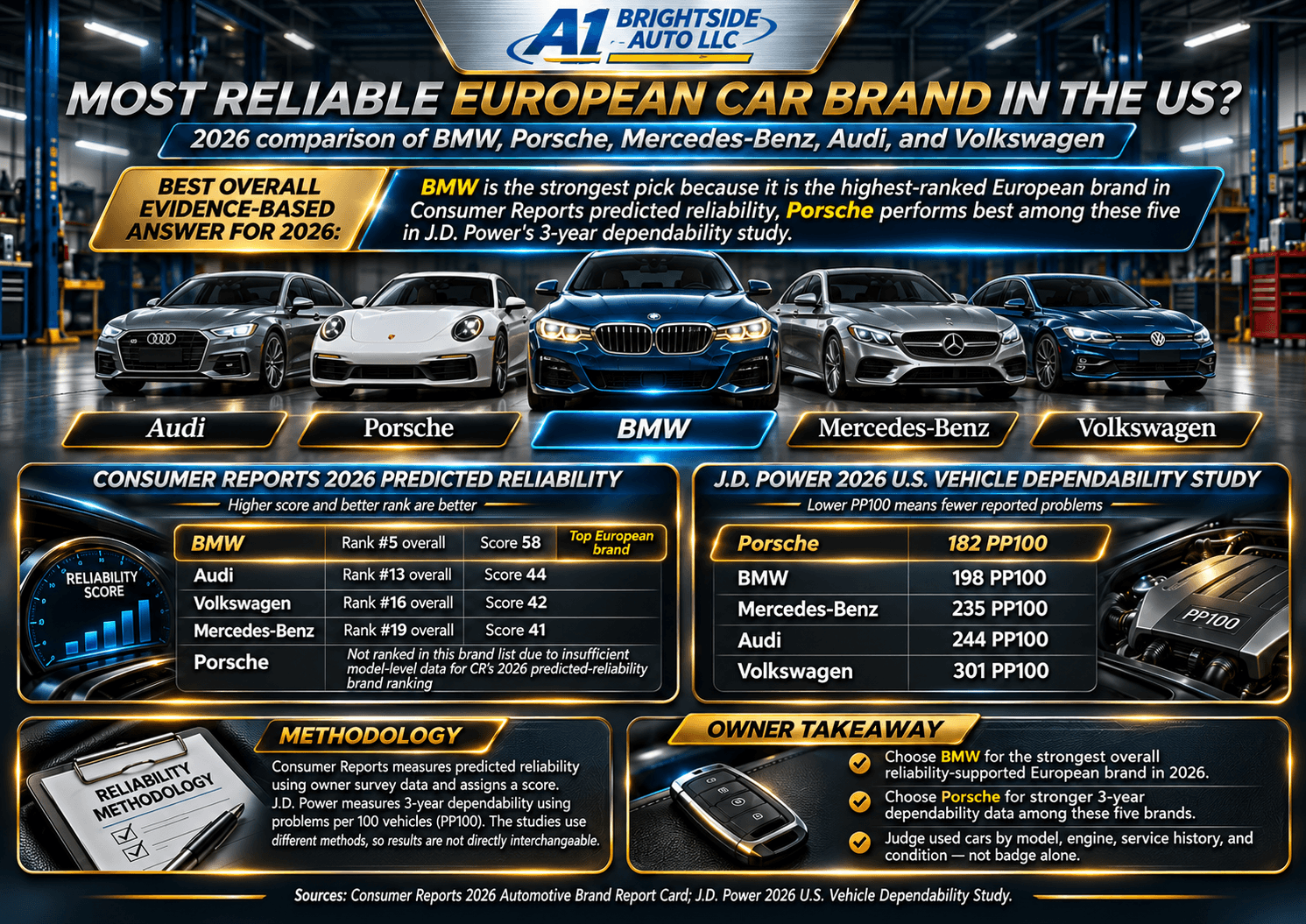
BMW is the highest-ranked European automaker in Consumer Reports' 2026 predicted-reliability survey. It places fifth overall with a predicted-reliability score of 58 out of 100. Consumer Reports reports that BMW's included models earned average or better predicted reliability.
Porsche leads BMW, Mercedes-Benz, Audi and Volkswagen in J.D. Power's 2026 US Vehicle Dependability Study. Porsche records 182 problems per 100 vehicles, compared with BMW's 198. Lower numbers indicate fewer owner-reported problems in that study.
Therefore, BMW has the strongest result among the five in Consumer Reports' new-car reliability data, while Porsche leads the five on J.D. Power's three-year dependability measure. Porsche was not included in Consumer Reports' 2026 predicted-reliability brand ranking because the available model-level data were insufficient.
For an individual purchase, the specific model, model year, engine or powertrain, maintenance records and condition matter more than relying on the brand name alone.
2026 European Car Reliability Rankings at a Glance
Rather than combining unlike scores into a made-up overall ranking, the table below shows each study separately.
| European Brand | Consumer Reports 2026 Predicted Reliability | J.D. Power 2026 Dependability |
|---|---|---|
| BMW | 58/100; 5th overall | 198 problems per 100 vehicles |
| Porsche | Not ranked; insufficient eligible model data | 182 problems per 100 vehicles |
| Audi | 44/100; 13th overall | 244 problems per 100 vehicles |
| Volkswagen | 42/100; 16th overall | 301 problems per 100 vehicles |
| Mercedes-Benz | 41/100; 19th overall | 235 problems per 100 vehicles |
How to read the table: A higher Consumer Reports reliability score is better. A lower J.D. Power problems-per-100-vehicles figure is better. The two scales cannot be compared directly or averaged into a meaningful single reliability percentage.
In J.D. Power's 2026 study, the industry average was 204 problems per 100 vehicles. Porsche and BMW performed better than that benchmark; the other three brands in this five-brand comparison recorded higher problem counts.
Sources: Consumer Reports 2026 Automotive Brand Report Card and J.D. Power 2026 US Vehicle Dependability Study.
European Car Reliability Infographic: BMW vs. Porsche, Mercedes, Audi and VW
The following visual compares all five brands using 2026 US reliability findings. It highlights why BMW is a strong choice based on predicted reliability while Porsche performs better in the separate three-year dependability study.
Scope clarification: This comparison focuses on the five brands selected for this article. Other European manufacturers, including MINI and Volvo, also appear in US research. The term "most reliable European brand" should always be connected to a specific study and eligible brand population.
How Do Consumer Reports and J.D. Power Measure Reliability?
Understanding the methodology is essential because the word reliability can mean different things in automotive research.
BMW: Consumer Reports
BMW's predicted-reliability score in CR's 2026 brand comparison. Higher scores are better.
Porsche: J.D. Power
Porsche's result in the 2026 US Vehicle Dependability Study. Lower scores are better.
US Industry Average
The overall benchmark reported by J.D. Power for its 2026 dependability study.
Consumer Reports: Predicted Reliability for New Vehicles
Consumer Reports gathers owner-reported information about vehicle problems and uses it to estimate the reliability of current and upcoming models. For its 2026 research, the organization analyzed survey information covering roughly 380,000 vehicles across numerous model years.
Its predicted-reliability methodology evaluates problem areas and weights the severity and impact of faults. The brand score is based on eligible models rather than a promise about every vehicle the manufacturer has ever produced.
Importantly, Consumer Reports also publishes an overall brand report card that includes additional factors such as road-test results, owner satisfaction and safety. That broader overall ranking is not the same thing as its predicted-reliability ranking.
J.D. Power: Problems After Three Years of Ownership
J.D. Power's 2026 US Vehicle Dependability Study examined 33,268 original owners of 2023-model-year vehicles after approximately three years of ownership.
The study covers 184 specific problem areas across categories that include powertrain, infotainment, controls, exterior, climate, seats and driving experience.
The results are expressed in problems per 100 vehicles, commonly abbreviated PP100. A score of 198 PP100 does not mean 198 percent of vehicles broke down. It is a standardized measure of the number of problems owners reported across the surveyed vehicles.
A study that counts infotainment glitches and other user-experience problems is broader than a simple tally of major mechanical failures.
Why the Two Results Differ
The studies involve different owner populations, time periods, scoring systems and inclusion criteria. Consumer Reports is predicting reliability of eligible current vehicles, while the 2026 J.D. Power study focuses on problems experienced by owners of 2023 vehicles.
Therefore, BMW's stronger predicted-reliability position and Porsche's stronger three-year dependability result are not contradictory.
Neither study directly provides a complete ten-year lifespan prediction, a universal repair-cost forecast or a guarantee about the condition of a specific used vehicle.
BMW vs. Porsche vs. Mercedes-Benz vs. Audi vs. Volkswagen: Brand-by-Brand Analysis
BMW Reliability in 2026
BMW stands out in the Consumer Reports 2026 predicted-reliability ranking. It was the highest-ranked European automaker and fifth overall, with all included models scoring average or better.
That is an encouraging signal for shoppers considering a newer BMW. It does not mean that every BMW engine, transmission or electrical system has the same reliability characteristics. A sports sedan, an SUV, a plug-in hybrid and a high-performance M model can differ significantly in their components and maintenance requirements.
BMW also recorded 198 PP100 in the J.D. Power study, better than the study's overall industry average of 204. It was behind Porsche but ahead of Mercedes-Benz, Audi and Volkswagen among the five brands examined here.
BMW's appeal extends beyond reliability scores. It offers a broad range of vehicles with different performance levels, comfort features and powertrain choices. But buyers should not let a favorable brand-level result substitute for researching the exact model and engine.
For example, an older used BMW may have age-related cooling-system, gasket, suspension or electrical concerns regardless of the reliability ranking assigned to newer models. Inspection and maintenance records remain essential.
Buyer takeaway: BMW is a particularly defensible choice for someone who values strong current predicted-reliability evidence and wants access to a broad European luxury lineup. The best purchase still depends on the specific vehicle.
Rocky Mount owners can learn about local BMW repair and maintenance services through A1 Brightside Auto.
Porsche Reliability in 2026
Porsche performed very well in J.D. Power's 2026 study, reporting 182 problems per 100 vehicles. It ranked third among premium brands, behind Lexus and Cadillac.
Among BMW, Porsche, Mercedes-Benz, Audi and Volkswagen, Porsche recorded the fewest problems in that study.
Its absence from Consumer Reports' 2026 predicted-reliability brand ranking should not be interpreted as a negative score or evidence of poor reliability. Porsche lacked sufficient eligible model-level data for that particular ranking.
As with other manufacturers, the ownership experience varies by model, model year and powertrain. A performance-oriented sports car and a family-oriented luxury SUV can carry different maintenance schedules, component designs and operating demands.
Another distinction is that dependability and affordability are not synonyms. Even when a car has relatively few reported problems, its replacement parts, tires, specialized systems or scheduled services may carry substantial costs.
Higher performance can also mean more demanding maintenance requirements, especially when a car is used in demanding conditions.
Buyer takeaway: Porsche deserves serious consideration when three-year dependability is a major priority, but evaluate maintenance expenses and the actual model before assuming it offers the lowest overall ownership cost.
Mercedes-Benz Reliability in 2026
Mercedes-Benz has a long-standing reputation for luxury, comfort and engineering, but its 2026 reliability results were weaker than BMW's in the two studies discussed here.
Consumer Reports placed Mercedes-Benz 19th overall in predicted reliability, with a score of 41. J.D. Power reported 235 problems per 100 vehicles, above the 204 industry average.
Consumer Reports also identified specific model-level concerns, including weaker performance for the E-Class and GLS within their respective categories.
These results should not be turned into a claim that every Mercedes-Benz is unreliable. Individual vehicle designs, model years and equipment configurations can perform differently from the average for the brand.
Advanced comfort, infotainment, driver-assistance and electronic systems also influence the owner experience measured in modern surveys. A vehicle may have a sophisticated driving experience while generating frustrations involving technology or controls.
For used Mercedes-Benz buyers, reviewing maintenance records, testing electronics and inspecting major mechanical systems is more useful than relying exclusively on a current brand ranking.
Buyer takeaway: Mercedes-Benz can remain an attractive choice for comfort and luxury, but its 2026 brand-level reliability evidence supports being particularly careful about model selection and pre-purchase inspections.
Audi Reliability in 2026
Audi ranked 13th overall in Consumer Reports' 2026 predicted-reliability ranking, recording a score of 44. That places it behind BMW but ahead of Volkswagen and Mercedes-Benz in the same survey.
In J.D. Power's 2026 study, Audi received 244 PP100, higher than BMW, Porsche and Mercedes-Benz among the five brands compared here.
Consumer Reports called attention to declining reliability for the Q4 e-tron, with reported issues involving areas such as electronics, climate systems and some battery or charging concerns. Those observations apply to the relevant surveyed models, not to every Audi vehicle.
Audi buyers should distinguish between gasoline-powered, hybrid and fully electric models because they have different components and potential failure categories.
Features such as advanced infotainment, driver assistance and all-wheel drive can add value for the owner, but they should be checked carefully when evaluating a used vehicle.
Maintenance history can matter greatly. Confirm that the particular Audi received the specified fluids and servicing, and that any outstanding recalls or manufacturer campaigns have been investigated.
Buyer takeaway: Audi can provide an appealing balance of design, technology and driving characteristics. Its 2026 reliability evidence suggests comparing individual models and powertrains carefully rather than assuming the whole lineup performs identically.
Volkswagen Reliability in 2026
Volkswagen provides a different position in the European market from premium-focused BMW, Mercedes-Benz, Audi and Porsche. Its lineup offers models intended to appeal to a broader range of everyday drivers.
In Consumer Reports' 2026 predicted-reliability results, Volkswagen ranked 16th overall with a score of 42. In the J.D. Power study, it reported 301 problems per 100 vehicles, the highest figure among the five brands in this comparison.
Consumer Reports identified model-level concerns involving the Taos and Jetta, which performed poorly in their respective categories.
However, the Volkswagen brand contains different models, engines and transmissions, and their actual ownership experiences can vary. A brand score does not prove that a particular vehicle will fail or determine its future repair bill.
Used Volkswagen shoppers should pay close attention to the specific model year and powertrain, service records, warning lights, fluid condition and any previous repairs.
A less expensive purchase price can make a vehicle appealing, but total ownership cost also depends on depreciation, insurance, servicing, fuel, tires and unexpected repair requirements.
Buyer takeaway: Volkswagen may offer an appealing entry point into European vehicle ownership, but its 2026 reliability results make careful model-specific research and inspection especially important.
Learn about Volkswagen repair services in Rocky Mount.
Are BMW and Porsche the Most Reliable European Brands Overall?
BMW and Porsche perform particularly well in the two studies central to this article, but that does not establish a universal winner across every study or every European brand.
For example, MINI, which is part of BMW Group, posted 168 PP100 in J.D. Power's 2026 study, better than Porsche's 182. MINI is not one of the five brands selected for the main comparison, but omitting it from the wider context could create an inaccurate impression.
Volvo also appears in Consumer Reports' predicted-reliability rankings, while other European manufacturers may have insufficient eligible data for specific studies.
Brand eligibility, survey coverage, regional model availability and the types of faults counted all influence the results.
The defensible conclusion is therefore precise: BMW led eligible European brands in Consumer Reports' 2026 predicted-reliability ranking. Porsche led the five selected manufacturers on J.D. Power's 2026 three-year dependability measure, although MINI performed better when considering a broader European-brand set.
Is BMW More Reliable Than Mercedes-Benz and Audi?
In the two major 2026 US studies reviewed here, BMW performed better at the brand level than both Mercedes-Benz and Audi.
Consumer Reports ranked BMW fifth, Audi 13th and Mercedes-Benz 19th in predicted reliability. J.D. Power reported 198 PP100 for BMW, 244 for Audi and 235 for Mercedes-Benz.
These findings support BMW's stronger comparative position in these particular data sets. They do not mean every BMW model is more reliable than every Mercedes-Benz or Audi model.
A carefully maintained used vehicle with a documented service history may be a better purchase than a neglected example from a higher-ranked brand.
For buyers choosing between specific vehicles, the most useful next question is not simply "BMW or Mercedes?" It is which model year, engine, mileage and condition represent the better ownership risk for the intended use.
Does European Car Reliability Mean Lower Maintenance Costs?
No. Reliability and maintenance cost describe different aspects of ownership.
Reliability generally concerns the frequency or likelihood of problems. Maintenance cost refers to expected scheduled work such as fluid service, filters, brake components, tires and inspections.
Repair cost is another distinct category. It concerns what may be required to correct a failure after a component or system stops performing as intended.
A car can be reliable but costly to maintain. It may need few unexpected repairs while still requiring relatively expensive scheduled services and specialized parts.
Likewise, an affordable-to-service car can experience frequent minor problems. Reliability rankings do not directly reveal the total cost of those events.
| Ownership Factor | What It Measures | Why It Matters |
|---|---|---|
| Reliability | Frequency or likelihood of problems | Helps evaluate unexpected disruptions |
| Scheduled maintenance | Routine work specified by the manufacturer | Determines predictable service obligations |
| Repair complexity | Parts and labor required to fix a fault | Influences the expense of individual repairs |
| Parts availability | Access to correct replacement components | Can affect repair timing and cost |
| Depreciation | Change in resale or market value | Influences total ownership economics |
| Vehicle condition | Actual mechanical and cosmetic state | Often more important than brand averages for used cars |
Before buying, request the applicable maintenance schedule and obtain realistic estimates for common scheduled services. Avoid relying on generic lifetime-cost figures that do not specify model, year, mileage, location or assumptions.
Which European Car Brand Is Best for Long-Term Ownership?
There is no single European manufacturer that will always provide the best ten-year ownership experience. The answer depends on the exact vehicle and the owner's needs.
Buyers who prioritize stronger current predicted-reliability evidence may find BMW attractive. Drivers who place more weight on the three-year dependability study may want to examine Porsche models.
Mercedes-Benz and Audi may appeal to buyers who prioritize particular luxury or technology features, while Volkswagen may suit drivers looking for a different purchase-price or vehicle-class position.
But brand preferences should not override practical considerations such as repair access, insurance costs, available maintenance records and how the car will be used.
New European Cars
For a new vehicle, examine the predicted reliability of the exact model and powertrain, not merely the manufacturer average.
Warranty terms, manufacturer maintenance requirements and available local service support are relevant because a favorable reliability prediction does not eliminate the possibility of repairs.
Used European Cars
For a used vehicle, condition, previous ownership, service records and the quality of any past repairs become increasingly important.
A used European luxury vehicle may have a lower purchase price than a new one, but maintenance and repair demands do not necessarily decline with market value.
Even when an owner reports no current warning lights, hidden fluid leaks, suspension wear, tire problems or unresolved electronic faults may be present.
That is why a vehicle-specific inspection is a stronger basis for purchasing than a brand reputation alone.
What Should You Check Before Buying a Used BMW, Porsche, Mercedes, Audi or Volkswagen?
A pre-purchase inspection helps evaluate the actual car rather than assuming its history from a brand ranking.
- Confirm the exact vehicle identification. Check the model year, engine or powertrain, trim and VIN against the listing and ownership paperwork.
- Review the maintenance history. Look for evidence of scheduled servicing, appropriate fluids and records of significant previous repairs.
- Investigate current warning messages. A warning that has been cleared may require diagnosis even if it is not illuminated during a brief test drive.
- Check for fluid leakage. Inspect relevant engine, cooling-system and drivetrain areas for active leaks or signs of previous repairs.
- Evaluate the transmission and driveline. Unusual shifting, vibration or noises should be investigated using model-specific diagnostic procedures.
- Inspect the suspension and braking system. Worn suspension components, tires and brakes can represent substantial upcoming expenses.
- Test electronic features. Verify the operation of climate control, infotainment, driver-assistance functions and other fitted equipment.
- Check safety recalls. Use an official VIN-based recall lookup rather than assuming that a brand's reliability score includes recall completion.
- Obtain an independent inspection. A qualified technician can assess the vehicle's current condition and identify additional questions for the seller.
In the United States, owners can check open safety recalls at NHTSA's vehicle recall lookup.
Remember that a clean history report does not replace a physical inspection. Some mechanical problems and incomplete maintenance records may not appear in a vehicle-history database.
Why Engine and Powertrain Choice Matter More Than a Brand Badge
Modern European manufacturers often use multiple engine families, transmissions and electrical architectures across a model lineup. Two vehicles with the same manufacturer badge may have very different ownership considerations.
A naturally aspirated gasoline engine, a turbocharged gasoline engine, a diesel, a plug-in hybrid and a battery-electric powertrain can have different service procedures and potential fault categories.
Some problems may involve conventional components such as gaskets, water pumps or suspension parts. Others may involve charging systems, battery-management electronics, infotainment or specialized controls.
Complexity does not automatically mean unreliability, but it changes which components need inspection and what technical expertise might be necessary.
For BMW buyers in particular, evaluating the exact engine and model-year history is more useful than assuming every BMW has the same maintenance requirements.
If you own a BMW and notice fluid or lubrication symptoms, a focused diagnosis is more effective than treating every warning as evidence of a common brand-wide problem.
What Can Reliability Studies Tell You About a Car That Lasts 150,000 Miles?
Reliability survey data can help identify trends, but a 2026 brand ranking is not a precise prediction of whether a particular car will reach 150,000 miles or more.
Long-term durability depends on many factors, including engine design, maintenance practices, operating conditions, repair history and previous owners' treatment of the vehicle.
J.D. Power's 2026 dependability research focuses on three-year-old vehicles, not a complete lifetime ownership period. Consumer Reports' predicted-reliability scores also should not be interpreted as guaranteed ten-year survival probabilities.
Buyers considering a higher-mileage European vehicle should pay attention to service records and upcoming maintenance requirements, including manufacturer-specific procedures for the engine, transmission and other major systems.
A well-maintained higher-mileage vehicle can be a sensible purchase in some circumstances, while an apparently inexpensive car with deferred maintenance may create significant expense soon after purchase.
The purchase decision should reflect the vehicle's condition and a realistic maintenance budget rather than mileage or brand name alone.
European Car Repair and Maintenance in Rocky Mount, NC
A1 Brightside Auto LLC serves drivers in Rocky Mount, North Carolina, and maintains dedicated service pages for BMW, Porsche, Mercedes-Benz, Audi and Volkswagen vehicles.
Whether you already own a European vehicle or are considering a used-car purchase, understanding its service requirements can help you make informed maintenance and repair decisions.
European vehicles are not interchangeable from a service perspective. Different engines, transmissions and electronic systems may require vehicle-specific procedures, fluids, parts and diagnostic approaches.
If your vehicle develops a warning light, fluid leak, unusual noise, vibration or performance concern, describe the symptoms and provide its year, model and engine details when contacting the shop.
Learn more about the relevant local service options:
- BMW repair and maintenance in Rocky Mount
- Porsche repair and service
- Mercedes-Benz repair and maintenance
- Audi repair and maintenance
- Volkswagen repair and service
Additional service information is available for engine repairs, transmission repair and oil changes.
Business: A1 Brightside Auto LLC
Address: 1826 Sunset Ave, Rocky Mount, NC 27804
Phone: (252) 231-3301
Hours: Monday-Friday, 8:00 AM-6:00 PM
Own a BMW, Porsche, Mercedes, Audi or Volkswagen?
Contact A1 Brightside Auto to discuss your European vehicle's symptoms or maintenance needs and confirm the services available for its particular model.
Explore BMW Services Call (252) 231-3301Frequently Asked Questions About European Car Reliability
1. What is the most reliable European car brand in the US in 2026?
BMW is the highest-ranked European brand in Consumer Reports' 2026 predicted-reliability ranking, placing fifth overall with a score of 58. However, Porsche has the best result among BMW, Porsche, Mercedes-Benz, Audi and Volkswagen in J.D. Power's 2026 three-year dependability study, with 182 problems per 100 vehicles. The two studies use different methods, so their findings should not be treated as a single universal ranking.
2. Is BMW more reliable than Mercedes-Benz?
BMW performed better than Mercedes-Benz in both 2026 studies covered here. Consumer Reports ranked BMW fifth overall with a score of 58, compared with Mercedes-Benz in 19th place with 41. J.D. Power recorded 198 problems per 100 vehicles for BMW and 235 for Mercedes-Benz. These are brand averages, not guarantees about individual models, engines or used-vehicle condition.
3. Is Porsche more reliable than BMW?
Porsche recorded fewer owner-reported problems than BMW in J.D. Power's 2026 US Vehicle Dependability Study: 182 versus 198 problems per 100 vehicles. However, BMW led European brands in Consumer Reports' separate predicted-reliability ranking, while Porsche was not ranked because of insufficient eligible model data. Neither result proves that every Porsche is more reliable than every BMW.
4. Is Audi or BMW more reliable in 2026?
BMW ranked ahead of Audi in the available 2026 US research. Consumer Reports gave BMW a predicted-reliability score of 58 and Audi 44. J.D. Power reported 198 problems per 100 vehicles for BMW and 244 for Audi. The difference supports BMW's stronger brand-level position in these studies, but prospective buyers should still compare the exact models and powertrains involved.
5. Is Volkswagen more reliable than Mercedes-Benz?
The answer differs by study. Consumer Reports ranked Volkswagen 16th with a predicted-reliability score of 42, compared with Mercedes-Benz 19th with 41. J.D. Power reported fewer problems for Mercedes-Benz, at 235 per 100 vehicles, than for Volkswagen, at 301. Because the methods and vehicle populations differ, these results cannot be combined into a universal winner.
6. Which German car brand is the most reliable?
BMW led German automakers included in Consumer Reports' 2026 predicted-reliability rankings. Porsche performed better than BMW in J.D. Power's 2026 three-year dependability results, though MINI, a British brand owned by BMW Group, had a still lower problem count. The answer depends on the study, eligible brands and whether the shopper is evaluating new or previously owned vehicles.
7. Are European cars more expensive to maintain than American or Japanese cars?
Maintenance expenses depend on the specific model, powertrain, parts, service schedule and local labor rates. Some European luxury models can have costly scheduled services or specialized replacement parts, but brand origin alone does not establish the expense of an individual vehicle. Reliability surveys measure problems, not total ownership cost. Buyers should obtain model-specific maintenance estimates before purchasing.
8. Which European luxury car is best for long-term ownership?
No single model can be declared universally best for long-term ownership based on a 2026 brand ranking alone. BMW has strong current predicted-reliability evidence, and Porsche performs well in three-year dependability data. However, long-term ownership depends on the model year, engine, mileage, maintenance, driving conditions and repair history. A vehicle-specific inspection and realistic service budget are essential.
9. Does a higher reliability score mean lower repair costs?
Not necessarily. A vehicle may experience fewer unexpected problems while still requiring expensive scheduled maintenance or specialized parts. Reliability rankings do not provide a complete estimate of repair labor, component costs, depreciation, insurance or service frequency. Compare the exact vehicle's maintenance schedule and typical repair requirements before assuming that a higher survey score means cheaper ownership.
10. Why was Porsche not ranked by Consumer Reports in 2026?
Porsche was not included in Consumer Reports' 2026 predicted-reliability brand ranking because the survey did not provide sufficient eligible model-level data. An unranked brand should not be treated as receiving a zero score or as performing worse than the ranked manufacturers. Porsche appeared separately in J.D. Power's 2026 study, where it recorded 182 problems per 100 vehicles.
11. Are BMW reliability rankings useful when buying an older used BMW?
They can provide broad context, but a current predicted-reliability ranking is not a substitute for inspecting an older used BMW. Different generations may use different engines, transmissions and cooling or electrical systems. Prior maintenance, accident history, existing faults, mileage and repair quality can affect the individual car more directly than a present-day brand average.
12. Where can I find European car repair services in Rocky Mount, NC?
A1 Brightside Auto LLC provides information about BMW, Porsche, Mercedes-Benz, Audi and Volkswagen repair and maintenance services at 1826 Sunset Ave in Rocky Mount, North Carolina. Drivers can call (252) 231-3301 to describe their vehicle's symptoms and confirm appropriate service availability. The exact diagnostic and repair approach depends on the make, model, engine and concern.
Final Verdict: Which European Car Brand Should You Choose?
If you want the clearest answer from Consumer Reports' 2026 predicted-reliability data, BMW is the strongest-ranked eligible European brand. It placed fifth among all ranked manufacturers and performed better than Audi, Volkswagen and Mercedes-Benz.
If you prioritize J.D. Power's research on problems encountered after three years, Porsche recorded the strongest result among the five brands examined in this article.
That distinction matters because neither ranking is designed to guarantee future repair costs, lifespan or the condition of a particular used car.
Choose the individual model that suits your driving needs, inspect its maintenance and repair history, verify applicable recalls and budget for the services it will require.
For European vehicle service information in Rocky Mount, North Carolina, A1 Brightside Auto LLC's BMW service page and its other manufacturer-specific repair pages provide local starting points.
Sources and Research Methodology
1. Consumer Reports — 2026 Automotive Brand Report Card, published December 2025.
Official explanation of predicted-reliability findings, brand positions and the underlying owner-survey methodology.
Read Consumer Reports' 2026 findings.
2. J.D. Power — 2026 US Vehicle Dependability Study, released February 12, 2026.
Official methodology and results based on owner-reported problems in three-year-old vehicles.
Read J.D. Power's 2026 study.
3. J.D. Power — 2026 Vehicle Dependability Study brand ranking chart.
Brand-level problems-per-100-vehicles values for BMW, Porsche, Audi, Mercedes-Benz and Volkswagen.
View the study chart.
4. National Highway Traffic Safety Administration — Vehicle Safety Recalls.
Official US safety recall lookup for individual vehicles.
Visit NHTSA.
5. A1 Brightside Auto LLC — European vehicle service pages.
Business information and local brand-specific repair services in Rocky Mount, North Carolina.
BMW |
Porsche |
Mercedes-Benz |
Audi |
Volkswagen.
Research scope: 2026 US automotive reliability studies available as of November 10, 2026. Consumer Reports predicted reliability and J.D. Power three-year dependability use different methods, eligibility standards and vehicle populations. The findings are not a universal prediction of longevity or total maintenance cost. Published brand scores should not be substituted for an inspection of an individual vehicle.